Tuesday, August 5, 2008

Hijab shopping


I find our hijab shopping expeditions more successful here in Algeria than in Saudi. My 12 year old daughter prefers to wear the 2 piece slip-on hijabs which are hard to find in Saudi in anything other than black or white low quality polycotton. For around about the same price I pay in Saudi, I am able to find nice quality fabric hijabs in various designs and colours.

There is Sajeda hijab and abaya shop just near to the Amir AbdelKader monument and another shop called Qasr Al-Muhajabaat just before the Quick hamburger restaurant on La Rue Larbi Ben Mhidi both stocking a variety of hijabs priced at 350-500 Dinar (20Dinars = 1Riyal/160Dinar = £1). The navy hijabs we bought for school from Qasr Al-Muhajabaat were 350 each or 500 for 2. The same shop also had some 'Buy 1 get 1 free' offers.

My daughter chose a few hijabs including the one below.

Monday, August 4, 2008

Amir Abdelkader


Briefly, Amir Abdel Kader was, "... a political and military leader who led a struggle against the French invasion in the mid-nineteenth century, for which he is seen by the Algerians as their national hero." He lived from 1808 - 1883 and died in Damascus.

The monument below is a statue of the Amir and stands in Algiers on the Rue Larbi.

Algeria's first international fast food restaurant, 'Quick' is right next to the monument along with other icecream shops and cafes.


Oh yes, and we did go into Quick as dd12 was desperate for a cheeseburger (kids!). It was packed in there contrary to what I had heard about the place being unpopular and too expensive. A Double cheeseburger with french fries and a Coke was 270Dinars (13.5Riyals; £1.70) - maybe a little expensive by Algerian standards but in line with the price in Saudi and Europe.

Sunday, August 3, 2008

Ketchaoua mosque

I have posted photographs of various mosques in Saudi Arabia and UAE but none of any mosques in Algeria yet so here are two which are very close together and both in the capital, Algiers. We went to Algiers during the week and our walk started from the Rue de la Lyre where the Ketchaoua mosque is situated.

Ketchaoua mosque (pronounced 'Ketchowa') which is at the foot of the Casbah has quite an interesting history. It was mosque then cathedral and then later, mosque once again. Originally it was built by the Ottomans but was coverted into a cathedral during French colonial times; it was restored back to a mosque in 1962.

"The Ketchaoua mosque (Djamaa Ketchaoua جامع كتشاوة), at the foot of the Casbah, was before independence in 1962 the cathedral of St Philippe, itself made in 1845 from a mosque dating from 1612. " *

The mosque has some very beautiful architecture as can be seen in the photographs I managed to snap.


You can just see the mosque in the picture below; there are crowds of people because the street just near to the mosque is the site of a popular market selling dates, clothing and other items.

Looking in the other direction you can see the Masjid El-kabir; it is the oldest mosque in Algiers apparently dating back to at least 1097.

M'hadjeb


Yesterday morning I sat with my sister-in-law for practical lessons in how to make M'hadjeb. It's something I have wanted to learn to make for a long time now so it's about time! M'hadjeb is similar in principle to the Pakistani/Indian Paratha in that it is a flat chapatti type of bread with a filling; in the case of M'hadjeb though, the dough is made from semolina rather than regular flour.
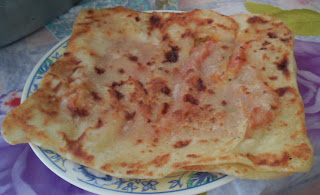


It is a very economical recipe at this time of year since semolina is a staple of North Africa and onions, tomatoes and peppers are in season and are cheap. Tomatoes are around 10Dinars/kilo (50halala/kg; 7p/kg)

The filling is made from equal quantities of chopped onions and peeled, seeded, chopped tomatoes. Sauté the onions until soft, add salt and the tomatoes, some chopped green pepper if desired and you can also add chili powder or caraway seed if you like. Cook until reduced and rich in flavour.

For the dough, pour semolina of medium coarseness into a large bowl - for my trial run I just used about 1 kilo of semolina and a teaspoon of salt. Pour on some tepid water and mix briskly with the hands and add enough water to obtain a dough that comes together and is kneadable.

Turn the dough out onto the table and start kneading and keep sprinkling with drops of water and pummeling, stretching and kneading. You probably need to sprinkle with water every minute. Knead really well for at least half an hour. We kneaded for about 20 minutes, covered and refrigerated and then continued in the morning for another 15 minutes.

You should finally have a soft, elastic dough that is quite sticky. You'll find that it is easy to knead but if you leave it for a moment, it sticks to the work surface. To test, break off a small piece and stretch into a rectangle, it should stretch easily and become quite sheer.

Form the dough into even sized balls, about the size of a tennis ball.

Oil the table and your hands and then take one piece of dough and with the hands smooth out and flatten the dough into a large square/rectangle. Holes don't matter too much but try to make it as even as possible and avoid very thick areas. Stretch any thick edges.
Bring the top edge down and fold to the middle of the square and then add a tablespoon of the filling and spread out to cover what will be the middle section.
Next, fold up the bottom edge, then the left side over as far as the final edge of the filling and then the right side. Pat down gently and make sure none of the filling is oozing out. Sprinkle with oil.
Carefully lift up the M'hadjeb and place on the hot plate which should be set over a medium to high heat.

Turn over with a palette knife and cook evenly on both sides.

They can also be made with no filling, and then sprinkled with sugar and eaten with coffee; these are Ma'aarek.
I'm hoping that these instructions will be an adequate reminder for me when I get back home in order to replicate what I made yesterday!

Friday, August 1, 2008

Cherchell


Cherchell Port


We took a drive along the coast to Cherchell during the week. It was a two and a half hour drive through some beautiful scenery: the Mediterranean sea to the right and fertile, green hills to the left. After Tipaza the road to Cherchell turned inland and the landscape became more lush: fields growing tomatoes, figs, plums and lots more besides. There were children at the sides of the roads selling baskets of freshly picked produce such as prickly pears and tomatoes.


My 4 year old son was delighted every time we drove past donkeys which are used quite a lot for labour in the area.

The actual town of Cherchell is quite old and run down like most towns I have visited in Algeria but it has a long and rich history dating back to 1500BC and the Ancient Egyptians. However it is best known for it's Roman ruins and the modern name Cherchell is the 'Berberisation' of the Roman name for the town, Caesarea.

The Masjid Er-Rahmane is quite a strange building built in the style of the Pantheon complete with Romanesque pillars.


We also drove past a Roman aquaduct coming back out of Cherchell going back to Tipaza but I missed the opportunity to photograph it. See a photograph here. Amazingly intact piece of architecture.